
Substitute Scheduling Software vs. a Staffing Agency
Before hiring a staffing agency, check whether your school ran out of substitutes or just made them hard to reach.
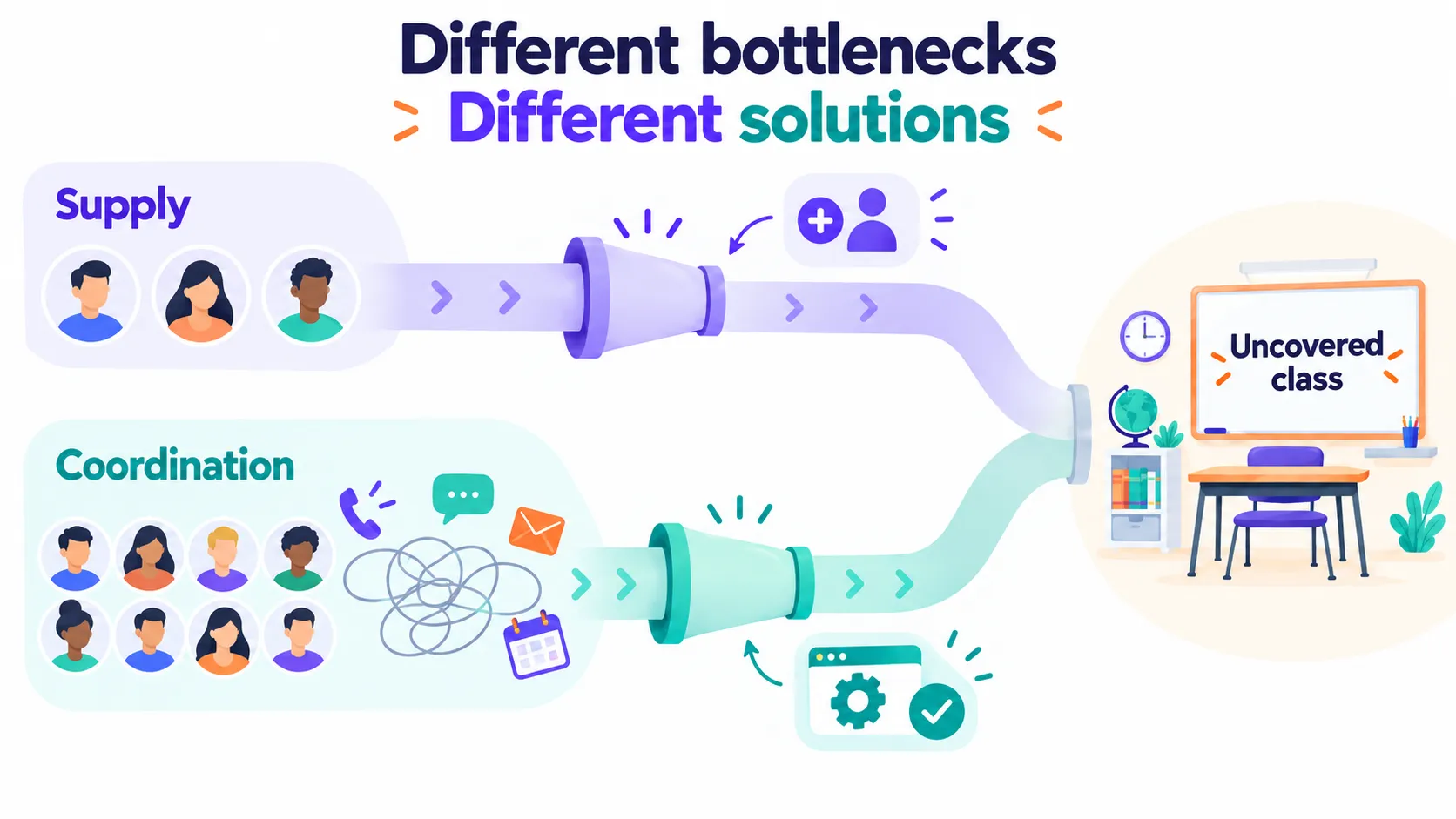
When a school struggles to fill substitute openings, “we need more substitutes” can feel like the obvious diagnosis.
But before bringing in a staffing agency, it is worth asking a more specific question:
Did we run out of substitutes, or did our process make it difficult to reach the substitutes we already have?
Those are different problems.
I learned that distinction while working in a school and building what eventually became FillMyClass. We had people we trusted to substitute. The frustrating part was the back-and-forth required to find out who could actually work.
So before comparing vendors or feature lists, look at where your own coverage process is breaking down.
Start with your last 10 difficult absences
Pull up the last 10–20 substitute requests that went unfilled or took too much effort to fill.
For each one, ask:
If the answer is consistently no, you probably have a substitute supply problem.
If the answer is often yes, but finding that person required calls, individual texts, emails, or repeated follow-up, you probably have a coordination problem.
And if you can’t answer the question because you don’t know which substitutes were active or available, you may have a third problem: the information in your substitute pool isn’t current enough to make good decisions.
A staffing agency can add supply
If your school simply doesn’t have enough people available to cover its absences, scheduling software cannot create another substitute. That’s where a staffing agency may make sense.
The exact services vary by provider, but K–12 staffing agencies generally bring their own pool of substitutes and take on the recruiting, vetting, and payroll that come with it. In other words, an agency can change who is available to work for your school. If you’ve contacted your entire qualified pool and nobody can take the assignment, that is the capability you’re paying for.
Scheduling software solves a different bottleneck
Now consider a school that already has 20 trusted substitutes.
The problem might be that someone in the office still has to figure out who is available, start sending messages, wait for replies, update everyone when the job is taken, and keep track of what is still uncovered.
Adding five more substitutes to that list doesn’t fix the workflow.
Good substitute scheduling software should help answer a few basic questions quickly:
- Who could actually work this job?
- Who needs to know about it?
- Has someone accepted?
- Which requests still need attention?
This is the side of the problem FillMyClass is designed to solve.
Substitutes can maintain their normal availability and days off. When a request is created, appropriate substitutes can be notified through push, email, or text. Preferred substitutes get the first opportunity. Administrators can see whether someone declined the request, if the request was outside the substitute’s availability, or if a specific substitute was already booked for another request.
The school still owns the substitute pool. The software makes that pool easier to coordinate, and that is the part of the workflow that costs your office staff the most time. We walk through what the process change looks like from manual to an automated system in How to Simplify Substitute Teacher Scheduling at Your School.
Sometimes the real problem is the pool itself
There is an important middle ground. A school might have 40 names in a spreadsheet but have no idea which 15 are still actively substituting.
Neither an agency nor scheduling software can tell you that on its own. First, you need a more accurate picture of the pool you already have.
We’ve written separately about this in How Big Is Your Substitute Teacher Pool, Really? A name on a list only matters if that person is active, appropriate for the assignment, available, and reachable.
Once you know where those gaps are, the next decision becomes much easier.
Use the bottleneck to choose the solution
A simple way to classify what you’re seeing:
| What keeps happening? | Likely problem | What to investigate |
|---|---|---|
| You reach your available subs and still have nobody to cover | Substitute supply | Recruiting or a staffing agency |
| You have available subs, but reaching them takes too much staff time | Coordination | Better process or scheduling software |
| You don’t know who is active or available | Pool data | Clean up the roster and track availability (FillMyClass does this) |
| Your own pool covers most days but occasionally falls short | Mixed | Scheduling software for your own pool, with recruiting or an agency as overflow |
The choice does not have to be agency or software. A school can run its own trusted pool through FillMyClass so those substitutes get the first opportunity on every request, and keep a recruiting effort or an agency in reserve for the days that pool cannot cover.
The important part is knowing which function you’re paying for, and not paying an agency to do the coordination your own pool could handle.
Where FillMyClass fits
FillMyClass is intentionally on the coordination side. Your school decides who belongs in its substitute network, and we make that network easy to reach.
FillMyClass helps teachers request coverage, gets those requests to the appropriate substitutes, lets substitutes accept them, and gives administrators a clear view of what is filled and what still needs attention. It also keeps each substitute’s availability current, so the pool-data problem above gets solved as a side effect of using it.
To be clear about the limits: we don’t recruit substitutes or send people from an outside pool. If there genuinely aren’t enough people willing or able to substitute for your school, you’ll need to recruit or work with a staffing provider alongside it.
But if you already have people you trust and your staff is spending too much time trying to reach and coordinate them, finding more substitutes may be solving the wrong problem.
Before signing a contract with anyone, review your last 10 or 20 difficult-to-fill absences and classify them.
Were there not enough people, or was it too hard to reach the people you already had?
Start there.