
How to Simplify Substitute Teacher Scheduling at Your School
Why coordinating substitutes by call, text, and spreadsheet breaks down as schools grow. A simple process fix that covers classes faster.
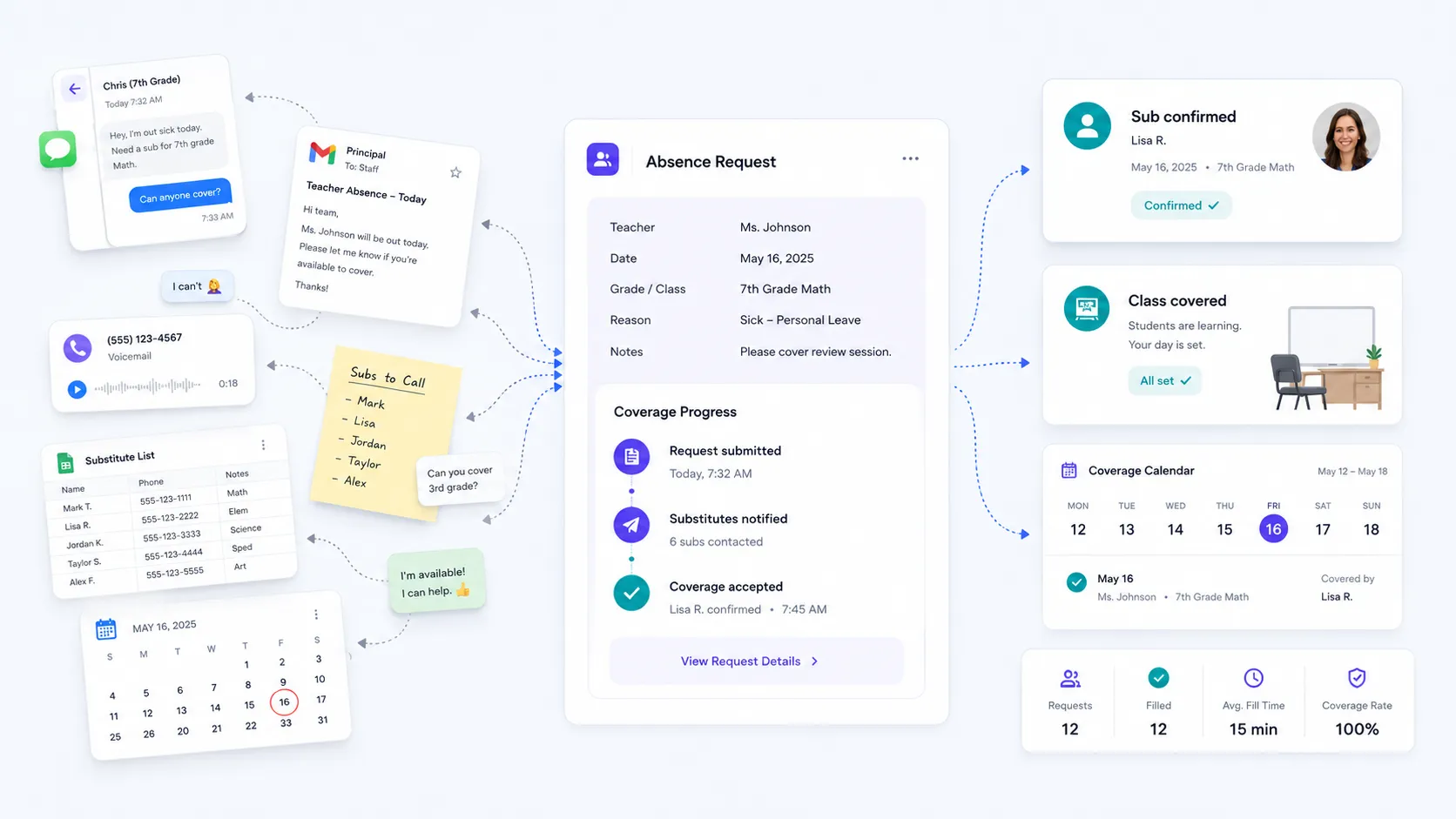
Some schools are still coordinating substitute teachers using manual processes. It often looks like this: A teacher calls out and notifies the substitute coordinator that they’re sick and need time off. The admin then starts working through a contact list by phone and text until a class is covered. It can work, but it is taking valuable time away from everyone involved.
The fix is simpler than most schools expect, and it isn’t hiring a staffing agency. It’s a process change: one request, sent to every qualified substitute at once, where subs claim the job themselves and everyone can see the status. Whether you get there with software or a very disciplined group chat, those four ingredients are what separate a five-minute fill from a ninety-minute scramble. Here’s why the traditional way breaks down, and what the better version looks like in practice.
The challenge: a teacher calls out, and the clock starts
Sometimes a teacher knows in advance that they need time off. Other times, they don’t know until 5:30 a.m., when their child wakes up sick. Regardless, someone needs to find coverage. Whether that responsibility falls to the teacher or an admin, the process often starts the same way.
Whoever that person is opens their contact list and starts at the top. Call, no answer. Text, wait. Try the next name while hoping the first one replies. Every minute spent coordinating is a minute not spent on the twelve other school-related tasks.
Why does the traditional process get messy?
At a small school with two or three regular subs, the phone-tree approach can hold up. The process falls apart as the school grows: more teachers, more absences, a bigger sub pool, maybe a second campus.
- Back-and-forth eats valuable time. “Are you available?” “Which class?” “What time?” “Actually, can I do the afternoon only?” Each exchange is minutes, and they stack.
- Two people contact the same sub. The secretary texts the sub list while the assistant principal calls it. A sub says yes twice, or two subs show up for one class, or each coordinator assumes the other has it handled and nobody covers the room.
- There’s no single view of “who said yes.” The answer lives across one person’s text threads, another’s voicemail, and a sticky note. When the principal asks “are we covered?”, someone has to reconstruct the state of the world by scrolling.
- Availability is a guess. You text people who are already booked at another school, on vacation, or done subbing for the season.
- Last-minute absences compress all of it. Everything above might be tolerable at 3 p.m. the day before. At 6:15 a.m. it’s a crisis.
None of this is anyone’s fault. It’s what happens when a coordination problem is handled through channels with no single source of truth.
What does a better process look like?
Four changes, and each one removes a specific failure above:
- One request captures everything up front. Date, times, class, grade level, notes for the sub. Nobody has to ask “which class?” ever again. The back-and-forth disappears because the answers travel with the request.
- Every qualified sub is notified at once, automatically. No phone tree, no double-texting, no forgotten names at the bottom of the list. One send, the whole pool. If the teacher has preferred subs, they need to be notified first.
- Substitutes accept for themselves. The first qualified person to claim it has the job, and the request closes for everyone else. Double-bookings become structurally impossible instead of carefully avoided.
- Everyone sees the status. Submitted, accepted, covered — visible to the admin and teacher in one place. “Are we covered?” becomes a glance, not an investigation.
Do you need a staffing agency for this?
Maybe.
Agencies solve a supply problem. If you genuinely don’t have enough substitutes, it may be worth it to hire a staffing agency.
However, many schools have their trusted network of substitutes. Think of the retired teachers, parents, and former staff. Their problem isn’t supply. It’s coordination.
If you have your own pool of substitutes, you don’t need a staffing agency. You need a better way to coordinate them. Improving how you work with your own substitutes is cheaper, faster to roll out, and helps maintain classroom continuity. The subs your students already know keep showing up.
How FillMyClass approaches it
FillMyClass is the four-step process above, built as an app. A teacher or admin creates the request from their phone in under a minute. The teacher’s preferred subs are notified first and get a head start to claim it; after a window you control, the request opens to the full qualified pool automatically. Subs get notified on the channels they actually check - push, text, or email. The first to accept gets the job. Admins can watch it all from their dashboard, across one school or several.
No outside staffing pool, no strangers. It runs entirely on the substitute network your school already trusts. Setup is simple, not a semester-long project: we configure your school, you invite people by email or with a join code. You can start requesting coverage the same day.
If your school already has substitutes but spends too much time coordinating them, FillMyClass was built specifically for that problem.