
How Big Is Your Substitute Teacher Pool, Really?
Why the number of names on your substitute list overstates real coverage, and four questions to find out who you can actually count on.
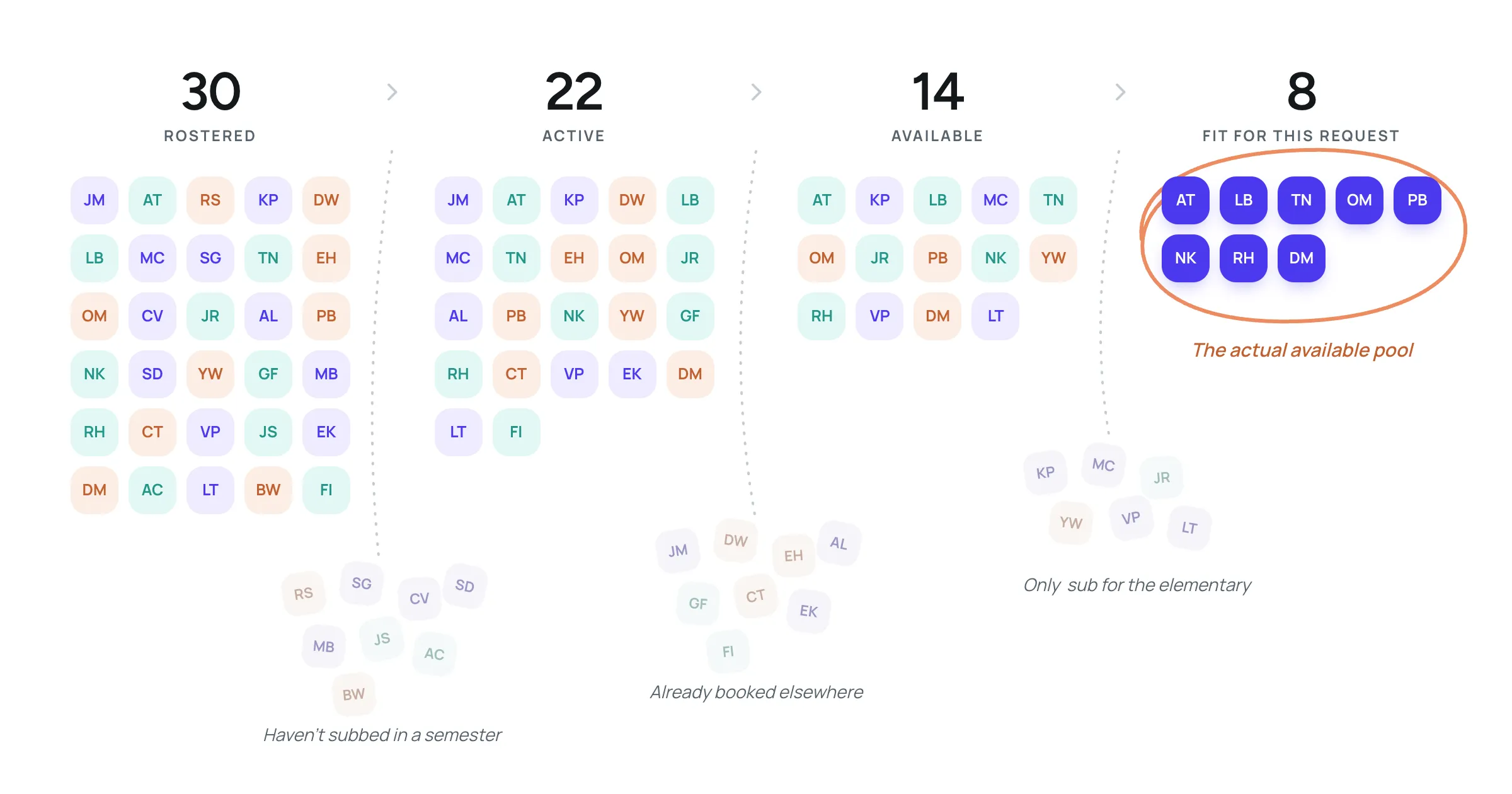
A school may have 25 people on its substitute list. That doesn’t necessarily mean it has 25 substitutes it can rely on.
Some may no longer be actively substituting. Some may only work certain days. Others may prefer certain grades, already be booked, or simply not be interested in the particular job you’re trying to fill. That’s why the number of names in your system can be misleading.
A better question is:
How many substitutes could realistically take the job you need covered?
This isn’t only a problem for schools using spreadsheets or call lists. A school can already use substitute management software and still have a poor picture of its actual pool if the information in that system isn’t current or useful.
A roster isn’t the same as coverage capacity
There are real examples of this distinction. During the 2024–25 school year, Danbury Public Schools reported having access to more than 200 pool substitutes through its staffing provider. On most days, the district covered over 90% of its absences; however, there were still days when only about 60–70% of needed coverage was filled. One reason was simple: substitutes in the pool could choose whether to accept the openings that were posted.
The American Association of School Personnel Administrators makes a similar distinction in its guidance for managing substitute programs. It recommends tracking substitute usage - active substitutes versus dormant ones - to understand the actual health of the pool. It also notes that pools can shrink throughout the year as substitutes move into other jobs or full-time positions.
For a smaller school, you probably don’t need a complicated workforce analysis to figure this out. But it is worth knowing what the number on your substitute list actually represents.
The four questions I’d ask about every substitute
When thinking about the size of your pool, run each person through four basic questions.
1. Are they still active?
Do they still want substitute work from your school? Someone who was approved two years ago but hasn’t responded to a request since then probably shouldn’t carry the same weight as someone who worked last week.
2. Are they a fit for this assignment?
A substitute may be active but only comfortable with certain grades, subjects, locations, or types of assignments. They’re still valuable, just not part of the realistic pool for every absence.
3. Are they actually available?
This is easy to overlook. Someone may regularly substitute for your school but only be available Monday through Wednesday. Another person may normally be available every day but be out of town next week.
If you don’t know that until after the request goes out, your pool looks larger than it really is.
4. Can they easily see and respond to the job?
Even an active, qualified, available substitute isn’t particularly useful for an absence if your process makes it difficult for them to know the job exists or respond in time.
That can happen with a manual process, but software doesn’t automatically solve it either. What matters is whether your current system gets the right opportunities to the right people and makes it easy for them to respond.
Put those four together and you get a much more useful view of your pool:
Active + appropriate for the assignment + available + reachable = someone you can realistically count on for coverage.
Try a quick audit of your own pool
Pull up whatever you currently use to manage substitutes. For every person on the list, see whether you can answer:
- When did they last work or confirm they’re still interested?
- Do you know their normal weekly availability?
- Do you know about temporary days they’re unavailable?
- Are there grades or assignments they prefer or won’t take?
- Can they easily receive and respond to an available job?
You may find that your list is in great shape. You may also find what we’ve seen firsthand: across the schools using FillMyClass this past spring semester, roughly two-thirds of the substitutes on rosters subbed at least once. The other third never worked a single day all semester. On paper, a full list. In practice, about two-thirds of the list. For any given request, fewer still, once availability and fit came into play.
Whatever you find, it’s useful information, because it tells you what problem you actually have.
Don’t automatically solve every coverage problem by recruiting more substitutes
If you’re struggling to fill jobs, adding more substitutes may absolutely be the answer. But first, look at where your existing pool is breaking down.
If too many people on the list are no longer active, you probably have a recruiting or retention problem.
If they’re active but you don’t know when they’re available, you have an information problem.
If they’re available but rarely accept jobs, it may be worth looking at pay, the substitute experience, the types of assignments being offered, or how much information they receive about a job.
And if good substitutes are available but jobs are slow or difficult to communicate, you may have a process or software problem.
Those are different problems, and they shouldn’t all get the same solution.
Why we added substitute availability to FillMyClass
I spent five years on staff at Brainerd Baptist School, where I built FillMyClass after seeing how much back-and-forth could go into securing substitute coverage. One thing we’ve continued to focus on is making the school’s existing substitute pool more useful.
That’s why FillMyClass now allows substitutes to maintain their regular weekly availability and enter days off. The goal is to give the school a more accurate picture of who can actually help when coverage is needed, even if the honest picture is a smaller list.
Whether you manage substitutes manually, use FillMyClass, or already have another system in place, that distinction matters.
The size of your substitute list is only one number. The more useful number is how much coverage that list can actually provide.
If coordinating your existing pool is taking more work than it should, you can also read How to Simplify Substitute Teacher Scheduling at Your School.